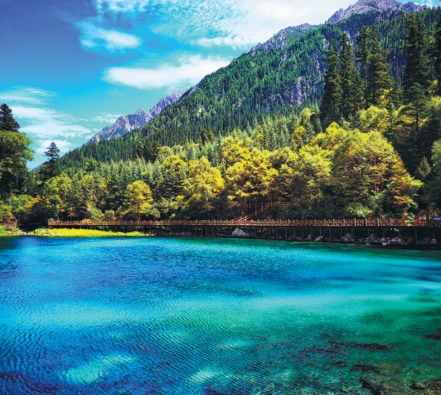
Jiuzhaigou Valley
Overview
Jiuzhaigou Valley, located in the northern part of Sichuan province, China, is an expansive nature reserve and a world-renowned scenic marvel. Spanning across 72,000 hectares, the valley is part of the Min Mountains on the edge of the Qinghai-Tibetan Plateau. Known for its stunning natural beauty, Jiuzhaigou is renowned for its multi-level waterfalls, colorful lakes, and snow-capped peaks. In 1992, it was inscribed as a UNESCO World Natural Heritage Site, marking its significance as a site of exceptional natural beauty and ecological importance.
Geography and Natural Features
Jiuzhaigou Valley is characterized by its remarkable landscape which includes a series of tiered waterfalls, serene lakes with vibrant colors ranging from turquoise to emerald, and towering snow-capped mountains. The valley lies at altitudes ranging from 2,000 to 4,500 meters, creating a unique alpine environment that supports a diverse range of flora and fauna. The colorful lakes, such as Five Flower Lake and Mirror Lake, are particularly famous for their crystal-clear waters, which reflect the surrounding forests and peaks.
Biodiversity
The valley's ecosystem is rich in biodiversity, making it an important habitat for various species of plants and animals. Jiuzhaigou is home to several endangered species, including the giant panda and the golden snub-nosed monkey. The diverse forest ecosystem provides a haven for numerous bird species, insects, and other wildlife, contributing to the valley's ecological significance. The area's flora is equally diverse, with over 140 species of birds and around 2,150 plant species recorded. Article reference1. Natural process. chinadaily.com.cn. 20222. Jiuzhaigou Valley. chinaservicesinfo.com. 2018Photo Gallery(7 pictures)CategoriesTourismTagWorld HeritageNatural WonderRelatedJiuzhaigou Valley Scenic and Historic Interest AreaCatalogue1. Overview2. Geography and Natural Features3. Biodiversity- - - []








